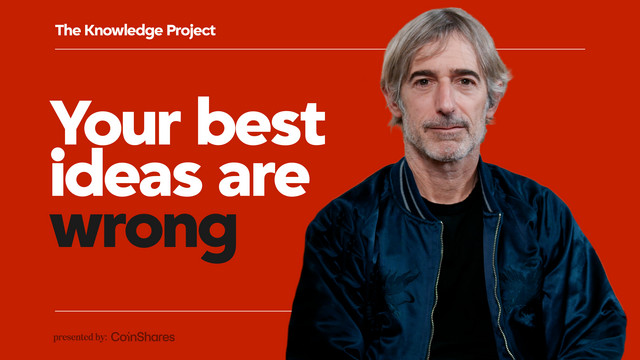
Proven, Better, New: Mark Pincus on the Rules of Product Innovation
The Knowledge Project·June 8, 2026
OVERVIEW
This episode features Mark Pincus, founder of Zynga, discussing his philosophy on product innovation, entrepreneurship, and life. He shares insights from his upbringing, early career failures, and the journey of building multiple successful companies, emphasizing the importance of instinct, deconstruction, and a unique approach to product development.
KEY TOPICS
- Product innovation philosophy
- The concept of "heat" or "true signal" in ideas
- Personal and professional failures as learning experiences
- The "Book of Life" and strategic personal growth
- Founding and selling Freeloader
- The challenges and lessons from Tribe.net
- The "Proven Better New" framework for product development
- The "Abyss" - a founder's period of uncertainty and re-evaluation
- The founding and massive success of Zynga
- Navigating the complex relationship with Facebook
- Mark's unique management style and leadership principles
MAIN TAKEAWAYS
- Great products connect with a deep, often unexpressed human need, creating a "magical" experience.
- Identifying "heat" or "true signal" in an idea is intuitive, like recognizing "your person" in a crowd; without it, data is just noise.
- Personal failures, like Mark's early career struggles and strained relationship with his father, can be pivotal moments for self-reflection and recalibration.
- The "Book of Life" encourages a strategic approach to personal development, focusing on actions today that your future self will appreciate.
- Founders' instincts are often right, but their initial ideas can be wrong; being too attached to an idea can lead to sticking with a "sinking speedboat" like Tribe.net.
- The "Proven Better New" framework advocates for legally copying what is already proven, finding incremental improvements ("better") that 10 out of 10 users would desire, and then adding truly "new", often unexpected, features.
- A core philosophy is "all new fails" until it doesn't, meaning entrepreneurs should test many small variants and new ideas, rather than banking on a single new concept.
- The "Abyss" is a common, often painful, phase for founders after a venture ends, characterized by a loss of structure and identity; embracing it and finding small projects to work on can be a path forward.
- Entrepreneurship can be driven by a deep "Why" – for Mark, it's building products that move people – which fuels passion and conviction.
- Mark's "Democratic Dictatorship" management style values every voice but maintains a single decision-maker, aiming for intellectual honesty over popularity.
- Effective leadership involves giving employees significant responsibility ("be the CEO of your outcomes"), demonstrating personal commitment, and focusing on meritocracy while being transparent about challenges.
- Trusting your "Founder Mode" means betting on your own instinct, even if it means taking less valuation for more control, and accepting the "right to be wrong" in pursuit of your vision.
- In product development, prioritize building "f** wrong" and fast over building "right" and slow; only build "right" once an idea proves itself.
- Voice interaction, replacing typing and texting, is predicted to be a future "obvious" technology that will fundamentally change how we interact with the digital world.
- True success, for Mark, isn't a singular achievement but a continuous process of building meaningful products, finding personal fulfillment, and collaborating with talented individuals.
NOTABLE QUOTES
"If we're starting with what if everything goes wrong, you're playing defense and you've lost before you're even out of the gates."
"You owe it to yourself to bet on your instinct. You owe it to yourself to lose because of yourself. It's your right to be wrong."
"Don't f*ing build it right, build it f*ing wrong and build it fast. And don't make it viable. Viable is the bad word."
Summarized with DriftNote — AI-powered podcast summaries
Try it free