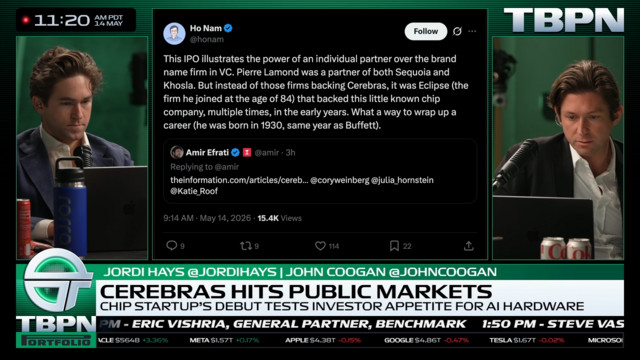
Cerebras IPO, WarshTime, General Catalyst Ad Reactions | Andrew Feldman, Amy Reinhard, Ben Hylak, Doug O'Laughlin, Eric Vishria, Steve Vassallo
TBPN·May 15, 2026
OVERVIEW
This episode provides an in-depth look at the Cerebras IPO, its technological innovations in AI chips, and the broader implications for the AI industry. It also delves into discussions about the new Fed Chair, a controversial advertisement by General Catalyst, and the ongoing Elon Musk vs. OpenAI trial.
KEY TOPICS
- Cerebras IPO and its market performance
- Cerebras' wafer-scale integration technology and its advantages for AI inference speed
- Challenges and future opportunities for Cerebras in scaling memory and model size
- Role of speed versus intelligence in AI models
- Kevin Warsh's confirmation as the new Fed Chair and his economic outlook
- General Catalyst's controversial advertisement targeting Andreessen Horowitz
- The "robot dog" debate and the responsible investing theme in venture capital
- Raindrop's new open-source tool for agent observability and the future of AI agents
- The Elon Musk vs. OpenAI trial's closing arguments and key points
- Discussion on the future of robotics and space data centers
- Market dynamics of the semiconductor industry, including TSMC and Intel
- Impact of AI on various industries and the definition of a "bubble"
MAIN TAKEAWAYS
- Cerebras achieved a highly successful IPO, with its valuation doubling overnight, demonstrating strong market demand for specialized AI hardware.
- The company's unique wafer-scale integration (WSE) technology offers significant speed advantages for AI inference, a capability highly valued by customers despite higher costs.
- While Cerebras excels in fast inference for certain model sizes, it faces challenges in scaling for larger context windows and memory, potentially positioning it as a complementary rather than sole solution in a diverse AI chip ecosystem.
- The confirmation of Kevin Warsh as Fed Chair signals a potentially challenging economic period, with debates on interest rate cuts amidst inflation and stagnation.
- The venture capital landscape is seeing increased competition and public "shots" between firms, highlighting differing philosophies on responsible investing and market positioning, though often backing similar companies.
- AI agents are rapidly diffusing across industries, from high-growth startups to Fortune 100 companies, with a focus on self-healing loops and closing the feedback gap in development.
- The Elon Musk vs. OpenAI trial underscores the complexities of foundational agreements in rapidly evolving tech, with both sides employing distinct legal and public relations strategies.
- The long-term vision for robotics, like space data centers, remains distant (8-12 years away), with current focus on industrial automation and practical, specialized applications rather than immediate humanoid deployment.
- The AI boom is considered by many to be a technological revolution larger than the internet, with profound implications for economic measurement and societal institutions, suggesting it's not a typical "bubble."
NOTABLE QUOTES
"The demand for inference will grow by a million x. And nobody believed him." - Andrew Feldman
"You can just sit back and you can ask yourself, I mean, how big is the market for for slow search? Zero." - Andrew Feldman
"The GPU isn't the only way. You've got a TPU, you've got Tranium, you've got us." - Andrew Feldman
Summarized with DriftNote — AI-powered podcast summaries
Try it free