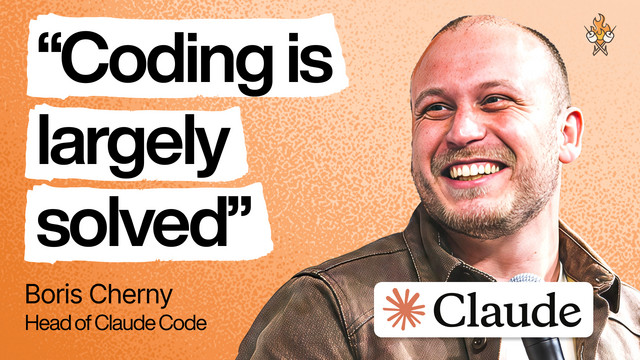
Head of Claude Code: What happens after coding is solved | Boris Cherny
Lenny's Podcast: Product | Career | Growth·May 15, 2026
OVERVIEW
The episode features Boris Cherny, Head of Claude Code at Anthropic, discussing the profound impact of AI on software engineering and the broader tech industry. He shares his personal journey and reflections on the rapid evolution of AI-powered coding tools, predicting significant shifts in job roles and productivity.
KEY TOPICS
- Boris Cherny's brief departure from Anthropic and quick return, driven by the mission of AI safety.
- The rapid growth and impact of Claude Code, generating a significant percentage of GitHub commits.
- The evolving role of software engineers, with AI taking over most coding tasks.
- The future of AI beyond coding, including its role in general tasks and as a "coworker."
- Principles for building AI products: experimenting, under-funding teams, and encouraging speed.
- The concept of "latent demand" in product development, where AI meets unmet user needs.
- The historical analogy of the printing press and its implications for AI's impact on knowledge and access.
- The importance of AI safety and Anthropic's mission.
- The shift from specialized engineering roles to a "builder" mindset.
- Boris's personal coding habits, using Claude Code for 100% of his code.
- The ethical and societal implications of widespread AI adoption.
- Tips for individuals to thrive in the AI era, including becoming a generalist and understanding AI's capabilities.
- The rapid pace of change and the need to adapt to new AI models.
- The potential for AI to enhance job satisfaction by offloading tedious tasks.
- The idea of "unlimited tokens" as a perk for engineers to foster innovation.
MAIN TAKEAWAYS
- AI, particularly tools like Claude Code, has virtually "solved" coding for many tasks, leading to dramatic increases in engineer productivity (e.g., 200% increase at Anthropic).
- The role of a software engineer is transforming from writing code to higher-level tasks like defining problems, understanding user needs, and managing projects, potentially leading to new titles like "builder" or everyone becoming a "product manager."
- Innovation in AI often comes from experimentation, giving teams autonomy, and allowing models to explore beyond their initial intended uses (latent demand).
- The rapid evolution of AI necessitates a continuous learning mindset; those who can adapt and become generalists, understanding various disciplines, will be most successful.
- AI agents are becoming more capable, moving beyond conversational interfaces to actively use tools and interact with digital systems, impacting non-technical roles as well.
- The ethical implications of powerful AI are paramount, emphasizing the need for open discussion and responsible development.
NOTABLE QUOTES
"100% of my code is written by Claude Code. I have not edited a single line by hand since November. Every day I ship 10, 20, 30 pull requests."
"Productivity per engineer has increased 200%."
"Coding is virtually solved. I imagine a world where everyone is able to program. Anyone can just build software anytime."
"The title software engineer is going to start to go away. It's just going to be replaced by builder."
"I have never enjoyed coding as much as I do today because I don't have to deal with all the minutiae."
"I think by the end of the year, everyone's going to be a product manager and everyone codes."
"It's so easy to get used to it, but it's important to recognize this is crazy."
"Just think about how do you give the model the tools to do things? Don't try to over-curate it. Don't try to put it into a box. Don't try to give it a bunch of context up front. Give it a tool so that it can get the context it needs. You're just gonna get better results."
"The model changes so often that I sometimes get stuck in this old way of thinking about it."
"I think for me, coding is very much a tool. It's a way to do things."
"I imagine a world a few years in the future where everyone is able to program. And what does that unlock? Anyone can just build software anytime. And I have no idea."
Summarized with DriftNote — AI-powered podcast summaries
Try it free