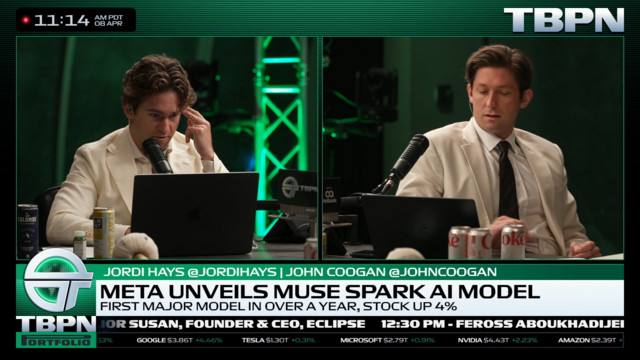
Meta Drops New Model, Mythos, RoboLamp | Luther Lowe, Dan Primack, Lior Susan, Feross Aboukhadijeh, Qasim Mithani, Jaleh Rezaei, Jeremy Philip Galen
TBPN·April 9, 2026
OVERVIEW
The episode discusses Meta's new AI model, Muse Spark, and Anthropic's Mythos, examining their capabilities, market positioning, and the implications for open-source AI and cybersecurity. It features interviews with various experts who delve into topics ranging from AI's impact on business and defense to venture capital trends and the ongoing challenges in software supply chain security.
KEY TOPICS
- Meta's new AI model, Muse Spark
- Anthropic's Mythos AI model
- Open-source AI strategy vs. closed-source models
- AI's role in cybersecurity and bug finding
- Market reaction and stock performance (Meta, Nvidia)
- Venture capital trends and IPOs
- Software supply chain security and AI-powered defense
- AI's impact on various industries (tech, defense, finance)
- Social engineering and AI-driven scams
- The future of AI models and compute constraints
- Entrepreneurship and building companies in the AI era
MAIN TAKEAWAYS
- Meta is shifting towards a closed-source AI model with Muse Spark, signaling a potential move away from its previous open-source strategy for future large language models, likely driven by the need for ROI on significant R&D investments and competitive pressures.
- Anthropic's Mythos model demonstrates impressive capabilities in identifying zero-day exploits and bugs, highlighting AI's growing potential in cybersecurity but also raising concerns about its misuse for cyberattacks.
- The cybersecurity landscape is becoming increasingly complex, with AI enabling more sophisticated social engineering attacks and supply chain compromises. Companies like Socket and Def First are developing AI-powered solutions for real-time threat detection and remediation.
- Venture capital investment is flowing heavily into AI, particularly in defense tech and companies leveraging AI for enterprise solutions. However, the IPO market remains bifurcated, with only a few major players expected to go public soon.
- The panelists expressed mixed views on the long-term impact of AI, from its potential to enhance human capabilities and improve security through continuous auditing to concerns about market homogenization and the ethical implications of AI-driven scams.
- There is a debate about the "democratization" of app development versus the walled gardens of major app stores (Apple, Google), with calls for policies that promote competition and protect smaller developers.
NOTABLE QUOTES
"When asked whether Meta will open source the future $10 billion cost model. The answer was: 'as long as it's helping us. At some point, they'll shift their focus towards profit'."
"It's a safer bet to commoditize your compliments."
"It's really not a matter of like if you're going to get hit when you're talking about these very, very widely deployed dependencies and, you know, including even some of my own code, right? I know I have these, you know, you picked on is even, you know, I have some code that is similar to that. Uh, a little bit less less outrageous uh of an example, but, you know, and and and it's in it's in every it's in, you know, probably almost every No JS app and that's just how that's just how the supply chain works today. So, um, it's it's really um, not surprising that, you know, everyone is going to get hit by this eventually."
"I think in the age of AI, I mean, as agents are everywhere, security is going to be like extremely important. So he's completely bought in to our vision and he's really excited about it."
Summarized with DriftNote — AI-powered podcast summaries
Try it free