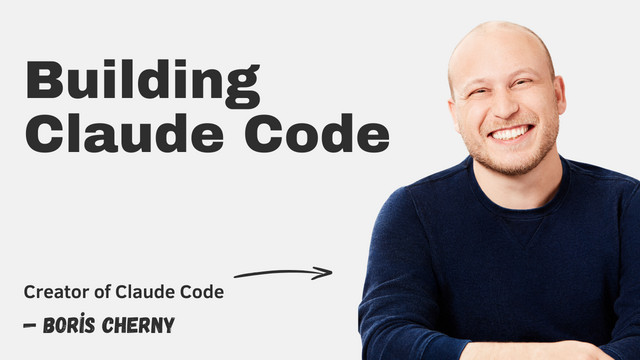
Building Claude Code with Boris Cherny
OVERVIEW
This episode features Boris Cherny, creator of Claude Code at Anthropic and former engineering leader at Meta, discussing the profound impact of AI on software engineering. He shares his career journey, the genesis of Claude Code from a rejected pull request to a widely adopted tool, and Anthropic's philosophy on AI safety and product development. The conversation highlights the changing landscape of engineering skills, the importance of adaptability, and how AI is transforming daily workflows and organizational structures.
KEY TOPICS
- Boris Cherny's early career in tech and startups
- Experience at Meta, leading code quality across major platforms
- The challenges and evolution of Instagram's tech stack
- The origin story of Claude Code and its internal development at Anthropic
- The internal debate and decision to release Claude Code to the public
- Boris's personal "Field AI moments" using advanced AI models
- The shift from conversational AI to agentic AI and its implications
- The importance of understanding underlying layers in tech stacks
- Measuring the impact of code quality on engineering productivity
- Anthropic's unique approach to engineering titles and generalist roles
- The role of prototyping and experimentation in AI development
- The future of software engineering and the "Printing Press" analogy for AI
- Skills that are becoming more or less valuable in the age of AI
- AI safety, prompt injection, and multi-layered defense mechanisms
- The architecture and daily workflow with Claude Code, including parallel agents and worktrees
MAIN TAKEAWAYS
The advent of AI in software engineering is a transformative event, comparable to the invention of the printing press, fundamentally altering how software is built and what skills are valued. Engineers need to shift their mental model of AI from a "model in a box" to an agent that uses tools and writes programs. Prototyping and experimentation are becoming crucial, as the cost of building is low, but the optimal path is often unknown, necessitating an exploratory approach. Code quality, though often underestimated, has a significant, measurable impact on engineering productivity, and AI-driven tools will further benefit from clean, well-structured code. AI safety and ethical considerations are paramount, especially for enterprise-grade AI products, requiring a human in the loop and multi-layered defense strategies. The traditional roles in software engineering are blurring, with a rise in generalists who can span product, design, engineering, and even finance functions. Adaptability, curiosity, and intellectual humility are key to navigating this rapidly changing environment.
NOTABLE QUOTES
Summarized with DriftNote — AI-powered podcast summaries
Try it free