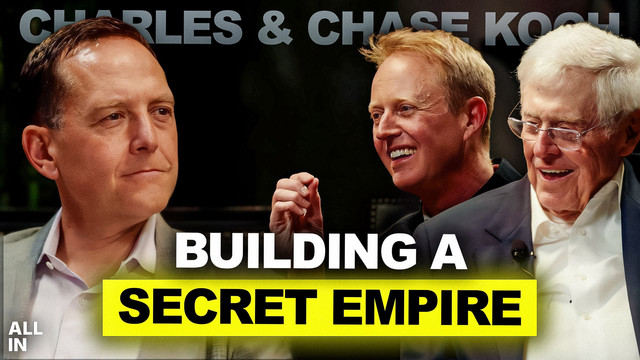
Charles & Chase Koch on How They Quietly Built a $150B Empire
All-In with Chamath, Jason, Sacks & Friedberg·May 12, 2026
OVERVIEW
This episode features an in-depth conversation with Charles Koch and Chase Koch, exploring the history, philosophy, and scale of Koch Industries, one of the largest private companies in the world. The discussion delves into how their unique principle-based management approach has driven exponential growth and transformation across diverse industries, emphasizing the importance of long-term vision, continuous learning from failure, and a "capability-bounded" strategy.
KEY TOPICS
- The history and scale of Koch Industries, including its diverse portfolio and growth from a small family business.
- Charles Koch's personal journey and his father's influence on his work ethic and philosophy.
- The "virtuous cycles of mutual benefit" principle and its application in business strategy.
- The concept of being "capability-bounded, not industry-bounded" as a driver for diversification and growth.
- The critical role of learning from failures and the importance of experimental discovery.
- The impact of culture and leadership on business success and the transformation of acquired companies.
- Koch Industries' talent vision, emphasizing values over credentials, and empowering employees.
- The distinction between contributing to society through meaningful work versus seeking power or pleasure.
- Koch Industries' approach to social change, focusing on removing barriers and driving human progress.
- The potential and challenges of artificial intelligence as an enabler of self-actualization or a tool for concentration of power.
MAIN TAKEAWAYS
- Koch Industries' success is rooted in a consistent application of principle-based management, fostering a culture where every employee is encouraged to contribute and learn from successes and failures.
- The company's growth strategy is not confined to specific industries but rather by applying core capabilities (e.g., operations, logistics) across different sectors where value can be created.
- Effective leadership focuses on bottom-up empowerment, enabling employees to take ownership and innovate, rather than top-down control.
- Cultivating a strong, principle-driven culture requires more than just communication; it demands consistent application, demonstrating success, and re-wiring the organizational mindset over time.
- True innovation and long-term value creation come from a willingness to experiment and embrace failures as learning opportunities, ensuring that the value gained from learning outweighs the cost of the experiment.
- Personal and organizational fulfillment comes from finding purpose and leveraging one's unique gifts to create value for others, moving beyond the pursuit of mere power or pleasure.
- Addressing societal challenges, including economic inequality and lack of mobility, requires removing systemic barriers that prevent individuals from realizing their full potential.
- Technology, like AI, can be a powerful tool for human empowerment if developed and applied with principles that prioritize widespread access and individual growth.
NOTABLE QUOTES
"If you're not failing at everything, you're not doing anything new."
"We don't have the capability to create superior value."
"We need to be capability-bounded, not industry-bounded."
"Success will drive social mimicry."
"The problem today is every more people have the means to live and no meaning to live for."
"Capitalism should be more accessible to all."
"If God is just, I despair for the future of our country."
"The proof of the pudding is in the eating."
Summarized with DriftNote — AI-powered podcast summaries
Try it free