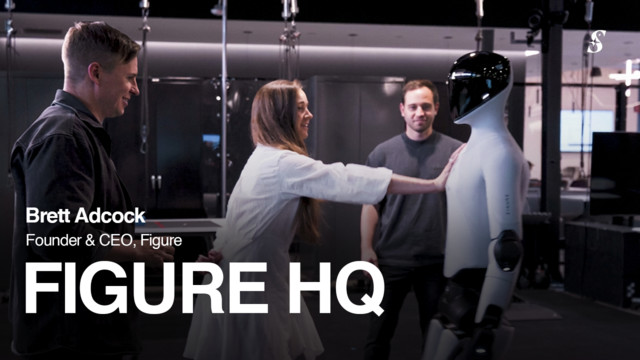
Figure’s Humanoid Factory Tour – CEO Brett Adcock
Sourcery·May 10, 2026
OVERVIEW
The episode features Brett Adcock, CEO of Figure, giving a tour of their humanoid robot facilities. It covers the company's mission to build general-purpose humanoid robots, their advanced AI and hardware development, manufacturing processes, and future plans for deployment in homes and commercial settings.
KEY TOPICS
- Figure's mission and vision for humanoid robots.
- Design, building, and testing processes for humanoid robots.
- The "Helix" AI policy and neural network control system.
- Robot capabilities: burpees, tidying houses, general tasks, navigating environments, self-charging.
- Manufacturing process at their "Bot-Q" facility.
- Testing procedures: stress testing, durability, software/hardware validation.
- Challenges in humanoid robot development: complexity of movements, AI control, power management, fall prevention.
- Deployment strategies for commercial and in-home use.
- Data collection and training for AI models.
- Future generations of Figure robots (Figure 1, 2, 3, and 4).
- Company culture and team structure.
- Safety features and ethical considerations (no harm to humans).
- Role of human-robot interaction and "pet parent" relationship with robots.
MAIN TAKEAWAYS
- Figure aims to create truly general-purpose humanoid robots capable of performing a wide range of tasks from housework to manufacturing, similar to human versatility.
- Their core innovation lies in the "Helix" AI policy, a vision-language-action model that uses neural networks to control complex robot movements from camera inputs, replacing traditional code-based control.
- The company prioritizes robust hardware development in conjunction with advanced AI, recognizing the interconnected challenges of physical dexterity and intelligent decision-making.
- Significant efforts are made in stress testing and quality assurance to ensure robots are reliable and fault-tolerant before deployment, including the ability to recover from mechanical failures like losing a knee.
- Figure envisions a future where robots are integrated into daily life, offering practical assistance in homes and various industries, with a focus on affordability and continuous improvement through data collection and software updates.
- The development process emphasizes overcoming the "curse of dimensionality" in robot control, leveraging simulation for training and achieving high sim-to-real transfer rates.
- Safety and human-robot interaction are central, with robots designed to operate autonomously without harming humans and capable of performing tasks collaboratively.
NOTABLE QUOTES
"Our goal is to be able to go out and basically design and ship humanoid robots in the world that can do everything from housework, dishes, laundry, to manufacturing, healthcare, just basically as much things in the world as possible that we can go out and ship robots to."
"What is this? This is the robot campus. Robot campus. We make humanoid robots here. We design them, we build them, we test them, all here."
"Basically, I think we spend a lot of time thinking what are all the things that can happen to the robot in the real world and then make them happen in simulation. I think that's the... that's the key."
"You can't write code to make this work. So all of our robots here run on a neural network we call Helix."
"If we lose power, the robot falls. So we can like never lose power, we can never lose comms, and then we need to be able to balance at all times everywhere we're going."
"It's not bad, right? Which is unbelievable that we can even do this kind of work."
"It's like iPhone, you know what I mean? Like everyone's getting better. So there are some things we just didn't get to and had enough time to work on on Figure 3 that we want to de-risk. We're putting it into 4."
"For me, I think it's like almost the perfect humanoid robot I can think of. I'm sure there's things on 5 and 6 as we iterate through it'll be even better."
Summarized with DriftNote — AI-powered podcast summaries
Try it free