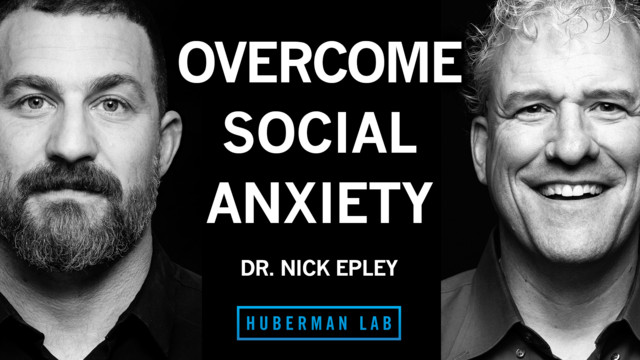
How to Overcome Social Anxiety | Dr. Nick Epley
Huberman Lab·May 18, 2026
INVESTMENT OPPORTUNITIES
Wealthfront: Offering the Huberman Lab audience an exclusive 0.75% APY boost over the base rate for three months, meaning up to 4.05% variable APY on up to $150,000 in deposits. Available at wealthfront dot com slash huberman.
OVERVIEW
This episode features Dr. Nick Epley, an expert on social connection, discussing how to overcome social anxiety and the profound benefits of everyday social interactions. It explores the often-misplaced assumptions we make about others and how real-world exposure to connection can transform our beliefs about human nature and improve overall well-being.
KEY TOPICS
- Overcoming social anxiety through real-world exposure therapy rather than simulation.
- The science behind social connection and its positive impact on mental and physical health.
- Human tendencies to anthropomorphize and make assumptions about other people, often incorrectly.
- The importance of non-verbal cues like eye gaze and voice in understanding others' minds and intentions.
- The "underestimation of compliance effect" and how people are often more willing to help than we assume.
- The role of technology (texting, AI) in social connection, noting its limitations compared to in-person interaction.
- The evolutionary basis of human sociality and our innate drive to cooperate and connect.
- How small, routine social habits, like a "hello walk," can cumulatively enhance daily well-being.
- Dr. Epley's personal experience with his adopted daughter with Down syndrome as a testament to the power of unexpected connection.
- The value of older generations modeling positive social interactions for younger individuals.
- The idea that social interactions don't need to lead to lasting relationships to be meaningful; they can simply improve the present moment.
MAIN TAKEAWAYS
- Social anxiety is largely rooted in mistaken beliefs about how others will react; direct, real-world exposure helps correct these pessimistic assumptions, revealing people are generally kinder and more receptive than expected.
- Even brief, casual social interactions, often dismissed as "small talk," are crucial for human well-being and contribute significantly to overall happiness and a sense of connection to humanity.
- Communication via voice and eye contact provides rich, authentic information about a person's thoughts and emotions that text-based interactions cannot, making in-person connection more impactful.
- Humans are fundamentally hardwired for sociality and cooperation; fostering these connections, even with strangers, taps into a core biological need and dramatically improves life quality.
- Cultivating small, consistent habits of positive social engagement, like offering compliments or initiating brief conversations, serves as an effective, data-driven "intervention" for enhancing personal well-being.
NOTABLE QUOTES
"You're worried about getting rejected, go out and start asking people for help, and you'll learn that your fear is misplaced. That you get accepted more often than you might guess."
"When I was talking to him about this, he said, I went into this thinking I was going to develop thicker skin. I lost my fear of rejection, but it was because I changed how I think about other people. Other people are way kinder than I expect."
"What's a good day if not to string along a few good moments? And what's a good week. If not to string along a few days that have some good moments in them? And what's a good month, a good year, a good life. It's about those moments."
Summarized with DriftNote — AI-powered podcast summaries
Try it free