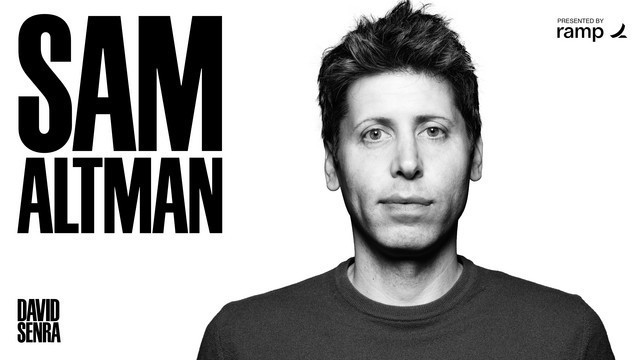
Sam Altman on Building OpenAI & Betting on the Impossible
David Senra·August 23, 2026
OVERVIEW
Sam Altman discusses his lifelong fascination with artificial intelligence, his journey from investor back to founder with OpenAI, and the company's unique philosophy in building AI. He emphasizes the importance of non-consensus thinking, aggressive development balanced with safety, and the societal impact of AI.
KEY TOPICS
- Sam Altman's early interest in AI and path to founding OpenAI.
- The philosophical approach to AI development and research at OpenAI.
- The importance of non-consensus bets and high-risk, high-reward ventures.
- Comparison of OpenAI's strategy to historical tech disruptions (e.g., Apple, industrial revolution).
- The role of rapid iteration and real-world deployment in ensuring AI safety.
- Challenges in human adaptation to new technology and changing established behaviors.
- The investor perspective providing unique insights for a founder.
- OpenAI's focus on foundational models and compute rather than myriad product categories.
- The ethical risks of AI, including loss of control and centralization of power, and human-centric approach.
- The historical optimism surrounding AI versus contemporary fears.
- The need for education and open dialogue about AI's benefits and risks.
- The influence of Y Combinator's philosophy on OpenAI's operational strategy.
- Personal experiences with inertia in adopting AI tools despite their potential.
MAIN TAKEAWAYS
- Sam Altman was fascinated by AI his whole life, but it seemed impossible until recently. He worked in an AI lab in college where deep learning was explicitly advised against.
- OpenAI's strategy is built on making non-consensus bets. They were initially "hammered" for pursuing AGI and then for large language models, but their conviction paid off.
- Humans have inherent inertia and resistance to change, making the adoption of even revolutionary technologies slower than anticipated. This is evident in everyday computer usage.
- His experience as an investor before founding OpenAI provided invaluable pattern recognition for leadership and strategic decision-making.
- OpenAI prioritizes building powerful, intelligent models and running them efficiently, believing that most other benefits will follow.
- AI safety is best addressed through iterative deployment, gathering real-world feedback, and continuously improving the models in collaboration with users, rather than developing in isolation.
- There's a deep human psychological flaw in thinking "it'll never do X" or "it'll never surpass what's happening at this current point." History shows constant progression.
- The risks of AI, such as loss of control or centralized power, often stem from an an anti-human perspective. Altman advocates for empowering people and ensuring human control over the future of AI.
- The AI industry, unlike past tech revolutions (e.g., Intel, Apple), has done a poor job educating the public on benefits and mitigation of downsides.
- The Y Combinator philosophy of "launch when you're embarrassed" and "move fast and be iterative" has been a critical guiding principle for OpenAI, particularly in navigating safety and product development.
- The world is on the cusp of an "iPhone moment" for AI where all technological pieces exist, but the "how-to-interface" moment hasn't fully arrived.
- Sam believes AI will empower many more small businesses and foster creativity, not just consolidate power.
NOTABLE QUOTES
"Every time I talk to him [Tobi Lütke], he is at the edge of what anyone, CEO or not, is doing. He builds himself, he understands, he has like a great deep feel, and he is always six, eight months ahead of like any other CEO."
"The economy just has so much inertia. People keep doing the same things they're doing. They keep buying from the same, you know, company. They keep sort of wanting to use their tools in the same way. I think this is actually a positive in many ways and it's going to make this big transition in front of us go smoother and slower. I'm grateful for it, but I think it means we've all been too ambitious on timelines, even with this incredible technology."
"The thing to me that feels most psychologically inconsistent about myself is that I have for 20 years been using computers the same way. I now have a magic thing called Codex... that means I should completely be using my computer in a different way."
"You don't want to fund a founder who has a very, slightly different take on the same idea as the last thousand people you talk to."
"We were very confident that we were going after AGI... and then when we started really focusing on large language models, we got hammered again saying this is completely ridiculous."
"This is the weird thing where everybody's just like, 'Oh, it'll never do X.' Like, I talked to people in the music industry, 'It's never going to make great music.' And then they're like, 'Well, do you think it's going to like make a podcast?' I was like, 'Of course it's going to. It's going to do everything that we can do, at least better than like, even right now, like better than what we can do.'"
"People are still going to be very fundamentally wired to care about other people, to want to be around other people, to interact with other people. And, you know, there will be some people who just like get obsessed with the models and just think humans are in the way or, you know, a danger to be contended with or whatever. And for most people, it'll be the whole point."
"The single most powerful pattern I have noticed is that successful people find value in unexpected places and they do this by thinking about business from first principles instead of formulas."
Summarized with DriftNote — AI-powered podcast summaries
Try it free