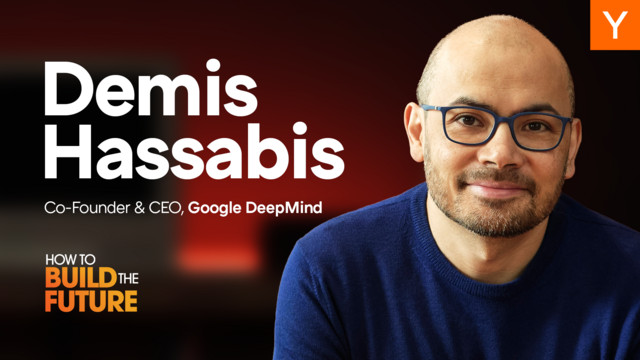
How to Build the Future: Demis Hassabis
OVERVIEW
This podcast episode features Demis Hassabis, CEO of Google DeepMind, discussing the past, present, and future of artificial intelligence, particularly focusing on the journey toward Artificial General Intelligence (AGI). He shares insights into DeepMind's foundational work, current challenges in AI development, and the potential impact of advanced AI on scientific discovery and various industries.
KEY TOPICS
- The path to Artificial General Intelligence (AGI)
- Unsolved problems in AI like continual learning and long-term reasoning
- DeepMind's achievements including AlphaGo and AlphaFold
- The role of distillation in making AI models efficient and accessible
- Challenges and future directions in scientific discovery using AI
- The importance of multimodality and agentic systems
- Strategic considerations for building deep tech companies in the age of AGI
- The role of open source and ethical considerations in AI development
MAIN TAKEAWAYS
The path to AGI is challenging, with fundamental issues in continual learning, long-term reasoning, and robust memory still largely unsolved. However, existing foundational models and techniques, especially DeepMind's work on agents and reinforcement learning, are crucial building blocks.
DeepMind excels at distilling powerful large models into smaller, highly efficient "flash" models, which is essential for deploying AI at scale across diverse devices for billions of users. This also lowers cost and latency, making AI more accessible.
AI is poised to revolutionize scientific discovery. Tools like AlphaFold demonstrate the power of AI to solve grand challenges in fields like biology, and similar breakthroughs are expected in materials science, mathematics, and medicine. The long-term vision is to use AI to solve fundamental root node problems in science.
Multimodality, the ability of AI to process and integrate different types of data (text, image, audio), is critical for developing AI systems that can understand and interact with the physical world, especially for applications in robotics and digital assistants.
When building a deep tech company today, it's crucial to anticipate the advent of AGI and design systems that can leverage it as a tool rather than being replaced by it. This implies a future where specialized AI systems might be orchestrated by a more general AGI.
Demis emphasizes that truly impactful and long-lasting innovation often comes from tackling hard, deep tech problems, combining AI with other scientific domains through interdisciplinary teams.
NOTABLE QUOTES
Summarized with DriftNote — AI-powered podcast summaries
Try it free