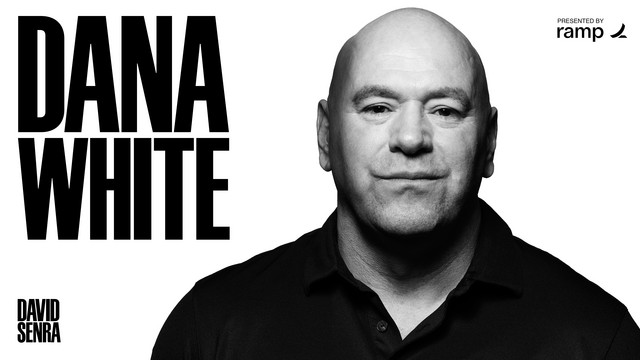
Dana White, UFC
David Senra·May 10, 2026
OVERVIEW
The episode is an in-depth interview with Dana White, President of the UFC, chronicling his journey from acquiring a struggling martial arts organization to transforming it into a multi-billion dollar global powerhouse. He provides candid insights into the numerous challenges, calculated risks, and unconventional strategies that propelled the UFC's success, emphasizing the critical roles of authenticity, relentless dedication, and unwavering belief in one's vision.
KEY TOPICS
- The UFC's challenging beginnings and initial financial difficulties.
- The acquisition of the UFC by Dana White and the Fertitta brothers for $2 million.
- Early operational hurdles including a lack of production experience, limited ancillary rights, and significant negative public perception.
- The pivotal role of "The Ultimate Fighter" (TUF) reality show in mainstreaming MMA.
- Strategic financial management, including stringent cost control and calculated investments.
- The decision to self-fund TUF and its long-term implications for content ownership.
- Adapting to evolving technologies such as DVDs, streaming, and social media.
- Dana White's personal entrepreneurial philosophy, emphasizing risk-taking and strong leadership.
- The importance of authenticity and direct, honest communication with the fan base.
- How to effectively handle critics and those who doubt your vision.
- The process of building a loyal, cohesive, and highly motivated team.
- The company's expansion into other combat sports, including Power Slap and jiu-jitsu.
- His high tolerance for risk and profound confidence in his business ventures.
- The strategic partnership with Joe Rogan and early embrace of podcasts and social media.
- Navigating the business through the unprecedented challenges of the COVID-19 pandemic and prioritizing employee well-being.
- The eventual sale of the UFC for over $4 billion.
- His hands-on approach to managing fighters and live events.
- An analysis of the differences between engaging live event experiences and televised broadcasts across various sports.
- The critical importance of a founder maintaining passion and vision, rather than delegating it entirely.
- His outspoken criticism of anti-capitalistic sentiments among younger generations.
MAIN TAKEAWAYS
- Authenticity is a foundational element for cultivating a dedicated fanbase and achieving enduring business success; openly addressing strengths and weaknesses of a product fosters deep trust with the audience.
- An unshakeable belief in one's vision, even in the face of widespread skepticism, is crucial for overcoming significant obstacles and executing bold, calculated risks. Dana White consistently demonstrates this by following his instincts and challenging conventional wisdom.
- Securing content ownership, particularly in the nascent stages of a business, offers substantial long-term leverage and opens doors for exponential growth, as demonstrated by the UFC's strategy to reacquire all its ancillary rights.
- A proactive approach to adopting and leveraging new technologies (e.g., DVDs, streaming, social media) is vital. Embracing technological evolution, rather than resisting it, can provide powerful momentum for business expansion.
- Entrepreneurship inherently involves embracing substantial risks and a readiness to encounter failure. True entrepreneurs are driven by an intrinsic passion to create and build, not by a pursuit of comfort or an aversion to loss.
- Assembling a dedicated, skilled, and ideologically aligned team that embodies the founder's vision and work ethic is indispensable for effective scaling. Dana consistently seeks out individuals who match his own level of passion and drive.
- A relentless focus on optimizing the customer experience, both for live attendees and television viewers, is key to fostering strong engagement and loyalty. The UFC's success stems from its ability to deliver a consistently compelling product across all platforms.
- Rigorous financial discipline and an unwavering commitment to controlling costs, even during periods of rapid growth, create opportunities to explore new ventures and navigate economic downturns.
- Disregard "zeros" - critics who lack personal experience in building or creating. The focus should remain on concrete actions and measurable results, rather than external negativity.
NOTABLE QUOTES
"I was telling you, dude, I watch your press conferences. I was telling I was having dinner with a founder of a $150 billion company like a couple days ago. And they're like, hey, can you help us hire or find somebody to be a chief storyteller? I was like, no, that's the founder's job. And they asked like, do you have any good examples? I go, watch Dana White's press conferences after the fights."
"I'm like, man, you don't ever edit a fight. You let the fight play out and the fans determine whether the fight is good or bad. And you can't control that."
"What do you think happened overnight from Lorenzo calls you, he's like, man, I'm burning, we're we're just dumping all this money. Try to see if you can find a buyer. Calls you back the next day. Well, I called him back and said, I think we could sell it six, seven, maybe eight million in that ballpark. He says, all right, I'll call you tomorrow. I'm literally driving to work the next day and he calls me and I'm like, mm, here we go. He's like, fuck it. That's exactly what he said, fuck it. Let's keep going. And he always says, it's it's pretty amazing what a what a good night's sleep can do for you. You know what I mean?"
"I believe that the world would continue to get smaller and everybody would be watching the fight at the same time on the same channel around the world."
"My biggest problem with the media, who the fuck are you and what the fuck have you ever done? Nothing. You're nobody and you've never done anything ever. Nobody's ever depended on you for a paycheck. Who are you to criticize anybody?"
"I could be a Bellman at 35. I could be a Bellman at 50. But I can only do this and take the risk when I'm young and like I have nothing to lose."
Summarized with DriftNote — AI-powered podcast summaries
Try it free