The Secrets of Claude's Platform From the Team Who Built It
AI and I·May 15, 2026
OVERVIEW
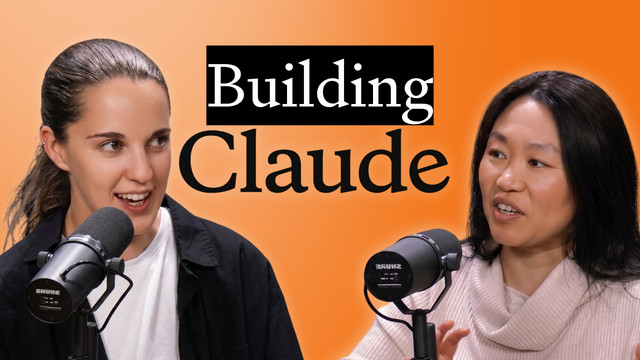
This episode features Angela and Caitlyn from Anthropic, who lead product and engineering for the Claude platform, respectively. They discuss the evolution of the Claude platform, from its initial API-centric model to its current state with Claude Managed Agents, and the philosophy behind building a robust, developer-friendly AI platform. The conversation delves into the challenges and opportunities of platform development in the rapidly evolving AI landscape.
KEY TOPICS
- The evolution of the Claude platform and the concept of an "AI platform"
- The philosophy behind developing Claude Managed Agents
- The increasing need for stateful and autonomous AI
- The "path dependency" in AI model development and its implications
- The target audience and use cases for Claude Managed Agents
- The role of infrastructure in AI development and productization
- The future vision for the Claude platform, including multi-agent orchestration
- Measuring success and managing the lifecycle of AI agents
MAIN TAKEAWAYS
- The Claude platform is evolving from simple completion endpoints to offering more sophisticated, stateful environments like Managed Agents, which are essentially a "Claude on a computer" with memory and other capabilities.
- The core mission is to make it as easy as possible for users to get the best outcomes from Claude, reducing the need for extensive "harness engineering" and complex infrastructure management.
- There's a "path dependency" in AI development where early architectural choices (e.g., how a model uses file systems or tools) can significantly impact its future capabilities and "personality."
- Claude Managed Agents are designed for both internal company automation (e.g., legal review of marketing copy) and for developers building AI products for their customers, aiming to abstract away infrastructure complexities.
- The hardest part of AI development often shifts from model training/harness engineering to productionizing and scaling agents, which frequently hits an "infrastructure wall."
- The platform aims to be modular and flexible, allowing users to integrate custom components while providing opinionated "primitives" to guide development and ensure optimal performance.
- The future vision involves even higher levels of abstraction, where users define an outcome and a budget, and the platform (potentially driven by Claude itself) handles the underlying model selection, architecture, and orchestration.
- Internal agents are commonly used for end-to-end development platforms, automating internal processes, and team-based workflows where collaboration and shared access to an agent are crucial.
- Measuring agent success is moving towards "verifiable outcomes" and a defined budget, with the platform handling the underlying complexities to achieve those parameters.
- Anthropic actively works on tools and features to help users upgrade agents, migrate to new models, and manage the lifecycle of agents, including retiring outdated ones.
NOTABLE QUOTES
"The platform has to seriously scale."
"I actually don't think you need to think so much about harness engineering in that world... Today, you don't have to think so much more aggressively about like tool construction for example... I think if you just keep going up that stack, like today a lot of the innovation is happening at this kind of like like really high level almost like harness architecture like level, which is really fun. But I think a lot of that honestly also kind of goes away where you almost like don't have to think so much about model selection, you don't have to think so much about what kind of architectures are there, because we've probably put have would have like gone through enough iterations with Claude where Claude is actually able to understand itself enough that it can almost like write itself on the fly to figure out what is necessary in that kind of like two-parameter world of like outcome and budget."
Summarized with DriftNote — AI-powered podcast summaries
Try it free