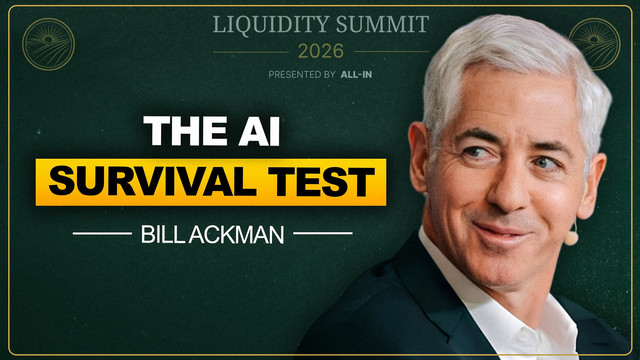
Bill Ackman: Investment Strategy, What the Market is Missing, How AI Breaks Businesses
All-In with Chamath, Jason, Sacks & Friedberg·June 4, 2026
INVESTMENT OPPORTUNITIES
- Microsoft, Meta, Amazon: Bill Ackman considers these companies undervalued, referring to them as "old-fashioned" in the context of the current AI craze. He implicitly suggests they are good long-term holdings due to their high quality and lower relative multiples.
- Durable, defensible businesses: In light of AI's disruptive potential, Ackman advises focusing on businesses with robust models that are less susceptible to rapid disruption.
- High-quality companies with low valuations: He noted that in the recent past, high-quality companies became "crazy cheap" on a fundamental basis (present value of future cash flows), presenting a significant buying opportunity.
- SpaceX: Ackman suggests underwriting SpaceX like a venture capital investment, emphasizing "people, opportunity, context, deal." He highlights Elon Musk's talent, the unique opportunity, and the incredible context, but points out that the "deal" (valuation) is the most complex factor. He is personally invested in X, XAI, and through an SPV in SpaceX, hoping for a good outcome but acknowledging he has not completed the full present value calculations himself.
- Pershing Square (management company): An investment in the management company (Pershing Square) is presented as owning a royalty on the compounding of investments in the three permanent capital vehicles it manages. This business has no capital expenditures, pays out all profits, and grows as quickly as the underlying assets compound. Historically, a $1 investment 22 years ago grew to $27-$28 net of all fees.
- PSUS: Investors can choose PSUS, which provides a portfolio of Pershing Square's best ideas and is currently trading at an 18% discount to cash.
- Howard Hughes Corporation: Ackman is in the process of transforming Howard Hughes, a real estate company, into a "compounding machine" by reinvesting its cash flow into insurance operations. He frames this as building the "next Berkshire Hathaway." He views this as owning a unique asset—a small city (26,000 acres in Summerlin, Las Vegas)—at a discount to liquidation value, which Wall Street has historically undervalued due to its long-term (decades) investment horizon. He aims to grow it into a trillion-dollar entity over 50 years.
OVERVIEW
Bill Ackman, CEO of Pershing Square, discusses his evolving investment philosophy, which now heavily emphasizes long-term, high-quality holdings. He offers his perspective on navigating the current market environment, including the opportunities and threats presented by artificial intelligence, and shares insights on building enduring businesses.
KEY TOPICS
- Evolution of Bill Ackman's investment strategy
- Importance of business quality and durable growth
- Role of activist investing and its changing nature
- Impact and implications of AI on business models and investment risk
- Market inefficiencies and identifying undervalued assets
- Public company governance and the board's role
- Advantages of founder-led companies
- Replication of Warren Buffett's investment approach, particularly with insurance
- The transformation strategy for The Howard Hughes Corporation
- Influence of social media on market dynamics and investor communication
- Pershing Square's various investment vehicles and their characteristics
MAIN TAKEAWAYS
- Ackman's investment philosophy has evolved to prioritize long-term, durable, and protected growth, shifting from aggressive short-term activism to a focus on concentrated, high-quality investments.
- The rapid advancement of AI significantly heightens disruption risk across all sectors, making it imperative for investors to evaluate business models through this lens and for companies to adapt or mitigate these threats.
- Market irrationality, particularly the gravitation towards "new, new things," can lead to established, high-quality companies (like Microsoft, Meta, and Amazon) becoming undervalued, presenting attractive investment opportunities.
- Effective leadership in public companies requires long-term vision, even if it means making decisions that may negatively impact short-term earnings, a strategy best supported by engaged and committed shareholders.
- Founder-led businesses often possess an inherent advantage due to the founder's deep personal stake, long-term perspective, and willingness to make bold decisions crucial for long-term survival and success.
- Ackman is applying lessons from Warren Buffett's Berkshire Hathaway model to The Howard Hughes Corporation, transforming a real estate company into an insurance-based compounding machine for sustained, tax-efficient growth over decades.
- While social media can amplify investor voices and even influence market sentiment, fundamental analysis and valuation based on future cash flows remain the ultimate drivers of long-term investment success.
NOTABLE QUOTES
"The biggest change over time is an appreciation for the importance of business quality: long-term, durable, protected, non-disruptible growth."
"What's interesting about markets is people always bring their eye to the new, new thing... What tends to happen is really high quality things get left behind."
"The higher a stock price goes... the more valuable the company becomes. The increase in value of the company increases the value of the company."
Summarized with DriftNote — AI-powered podcast summaries
Try it free