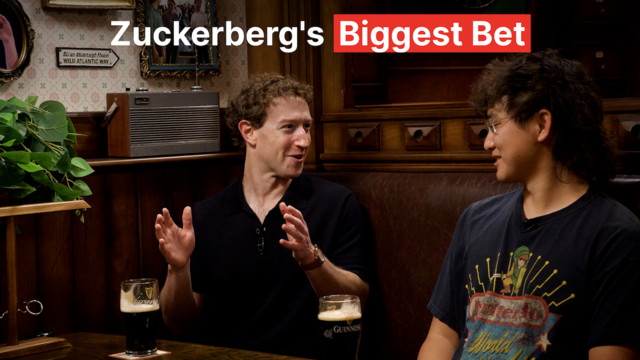
Muse Wonder: Zuckerberg and Wang's $100B AI
Cheeky Pint·October 14, 2026
OVERVIEW
This episode features a discussion with Mark Zuckerberg and Alexandr Wang about Meta's AI initiatives, particularly the new Muse Wonder model. They delve into the philosophy behind building "personal superintelligence," the challenges of frontier AI development, and the future impact of AI agents on commerce and daily life.
KEY TOPICS
- Muse Wonder: Meta's new frontier AI model
- Muse Spark: The previous generation of Meta's AI model
- Multimodal AI: Training models with diverse data types (images, audio, video)
- Personal Superintelligence: Developing AI agents tailored to individual users
- AI in MMA Coaching: Zuckerberg's personal use case for Muse
- The Product Space in AI: Discussion on product simplicity vs. complexity
- Model Training Stages: Pre-training, supervised fine-tuning (SFT), and reinforcement learning (RL)
- Talent Density in AI Labs: The importance of a small, highly skilled team
- Compute Infrastructure: Building massive data centers for AI training
- Financial Investment in AI: The tens of billions of dollars required for frontier AI development
- AI Agentic Commerce: How AI agents will transform shopping and business interactions
- Voice Interfaces for AI: Challenges and opportunities in conversational AI
- AI Safety and Alignment: Aligning AI with user values and goals
- Open Source AI: The role of distillation and diverse players in the ecosystem
- The Founding of Meta Superintelligence Labs (MSL): The strategic decisions and challenges
MAIN TAKEAWAYS
- Muse Wonder represents a significant leap for Meta's AI capabilities, designed to be a leading personal and professional agentic model with advanced memory, persistence, and domain expertise.
- Meta's strategy for AI development emphasizes multimodal training and creating "personal superintelligence" that can act as a team of experts for individuals, rather than just informational assistants.
- Training frontier AI models requires immense, long-term investments (tens of billions of dollars) in compute infrastructure and a talent-dense team, necessitating bold, high-stakes decisions years in advance.
- The future of commerce will increasingly involve AI agents, leading to "agentic commerce" where AIs perform tasks like shopping and managing subscriptions, potentially expanding the total addressable market and saving consumers time and money.
- The product development in AI is shifting towards the model being the product, with complex product work focused on privacy, security, capabilities, and personality trained directly into the model.
- Meta believes in an open and diverse AI ecosystem, supporting initiatives like OpenRouter, and sees AI safety as a matter of instruction and values alignment with the user, rather than a single, universal alignment.
- The success of MSL stemmed from a strategic reboot, a focus on talent density, a flat organizational structure, and Mark Zuckerberg's willingness to make massive, long-term bets and pivot the entire company's resources to align with the AI vision.
NOTABLE QUOTES
Mark Zuckerberg: "The model is the product."
Alexandr Wang: "The best personal agent should feel like a team of experts in your corner."
Mark Zuckerberg: "If AI works overall, plenty of other people want all our compute."
Mark Zuckerberg: "Life is short, just do the right thing."
Summarized with DriftNote — AI-powered podcast summaries
Try it free