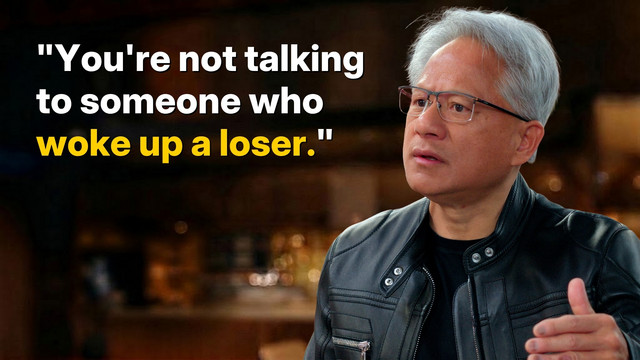
Jensen Huang – TPU competition, why we should sell chips to China, & Nvidia’s supply chain moat
OVERVIEW
Jensen Huang, CEO of NVIDIA, discusses the company's strategic competitive advantage in the AI industry, emphasizing its full-stack approach from hardware to software. He addresses the competition, the challenges and opportunities in the supply chain, and his perspective on global technology leadership, particularly regarding the debate around selling advanced chips to China.
KEY TOPICS
- NVIDIA's business model and strategic moat, centered on its CUDA software platform and extensive ecosystem.
- The fundamental "transformation of electrons to tokens" as the core of AI computing.
- The importance of NVIDIA's vertically integrated supply chain, including upstream commitments and downstream demand.
- The scalability of AI compute, addressing concerns about manufacturing bottlenecks in the industry.
- NVIDIA's expertise in co-designing hardware and software for optimal performance across various applications.
- Competition with specialized AI accelerators like Google's TPUs and those developed by companies like Anthropic and OpenAI.
- NVIDIA's philosophy of doing "as much as needed, as little as possible" to focus on core competencies.
- The role of innovation in algorithms and architecture as the primary driver of AI advancement, surpassing Moore's Law.
- NVIDIA's investment strategy in AI startups and its contribution to their growth.
- The "flywheel" effect of performance per dollar, performance per watt, and a large installed customer base.
- The ethical and practical implications of regulating the sale of advanced AI chips to China.
- The richness of the open-source AI ecosystem and its importance for global innovation.
MAIN TAKEAWAYS
NVIDIA's enduring success stems from its comprehensive, full-stack strategy, which goes beyond just hardware to include its CUDA software platform and a vast ecosystem of partners across the entire AI pipeline. This integrated approach, dubbed the "transformation of electrons to tokens," is complex and highly specialized, creating a powerful competitive moat that is difficult to replicate or commoditize.
Jensen Huang highlights NVIDIA's proactive management of its global supply chain, making significant upstream commitments and fostering downstream demand. He believes that while challenges like manufacturing bottlenecks exist, they are surmountable within a few years with clear demand signals, and NVIDIA's commitment to continuous innovation in both architecture and algorithms drives exponential performance gains beyond what traditional semiconductor scaling can offer.
NVIDIA's general-purpose accelerated computing platform is presented as inherently more flexible and versatile than specialized ASICs, enabling continuous algorithmic innovation crucial for the rapid evolution of AI. The company adheres to a philosophy of focusing on tasks where its unique expertise is indispensable ("as much as needed, as little as possible"), while collaborating extensively with partners for other elements.
Regarding the sale of AI chips to China, Huang argues against restrictions, asserting that such policies risk undermining US technology leadership by ceding market share and fostering Chinese self-sufficiency. He emphasizes that China possesses substantial resources (energy, engineers, existing manufacturing capabilities) and will ultimately develop its own advanced AI infrastructure, making collaboration and open dialogue vital for global AI safety and progress.
NVIDIA's business model thrives on a "flywheel" driven by superior performance per dollar, exceptional energy efficiency, and a massive installed base of users and developers. This combination, along with a commitment to nurturing the broader AI ecosystem, including open-source initiatives, ensures its continued leadership and ability to facilitate global AI advancements across diverse applications.
NOTABLE QUOTES
Summarized with DriftNote — AI-powered podcast summaries
Try it free